
Your Guide to Buying
New Construction in Florida.
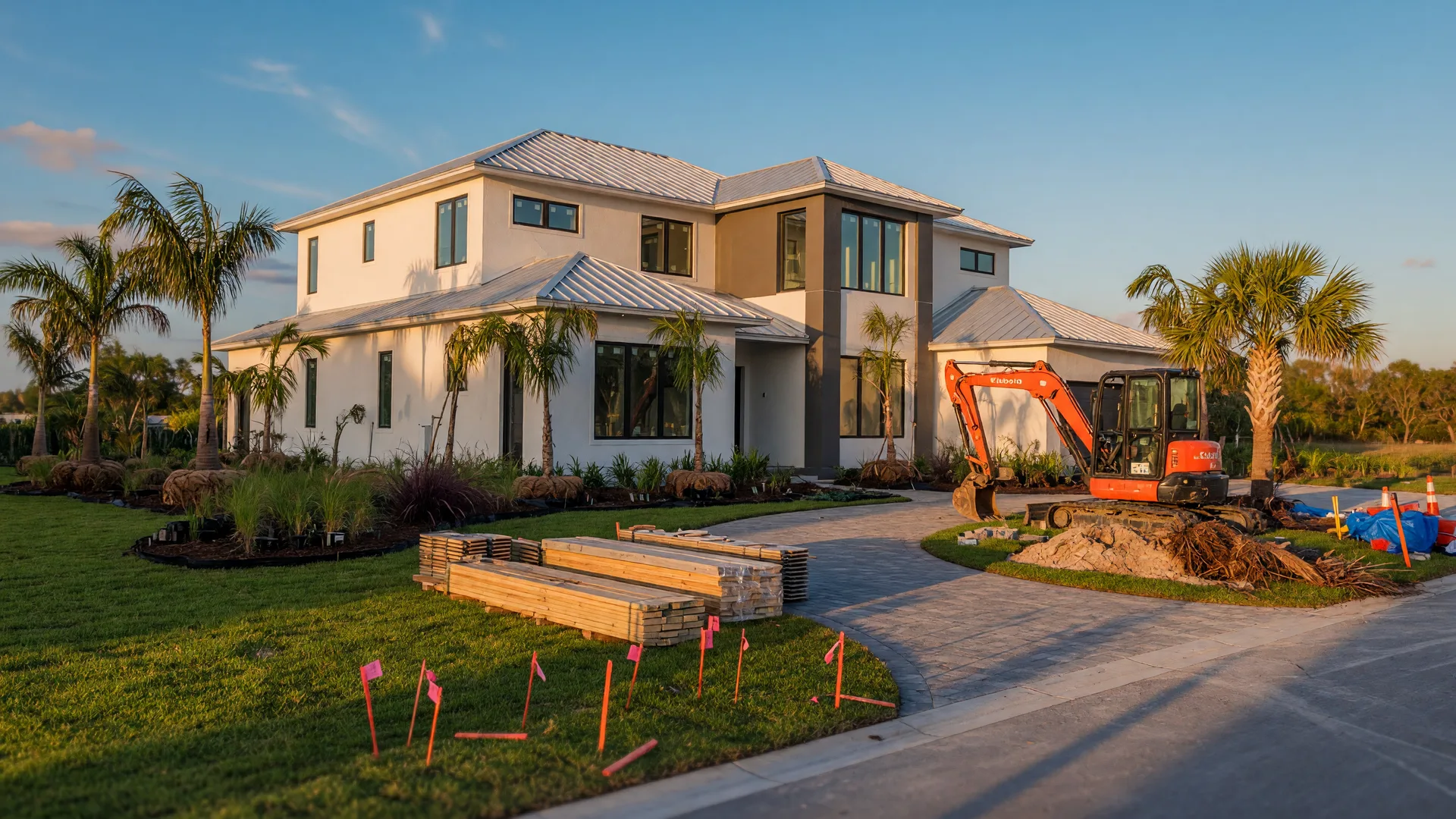
Buying a new construction home on the Gulf Coast is exciting, but the process is different from buying an existing home. From CDDs and impact fees to design centers and builder incentives, here is everything you need to know to make a confident, informed decision.
New Construction Is Not the Same as
Buying Resale.
Florida's Gulf Coast is one of the fastest-growing regions in the country, and builders are active across Sarasota, Manatee, and Pinellas Counties. New construction offers brand-new systems, modern floor plans, energy efficiency, and the ability to customize finishes. But it also comes with a vocabulary of its own — CDDs, impact fees, design center allowances, lot premiums. I have helped buyers navigate new construction contracts for years, and I want you to walk in prepared. Here is a complete guide to every term, cost, and strategy you need to know.
Florida New Construction
Terms Explained.
These are the terms every new construction buyer encounters. Understanding them before you walk into a model home will save you surprises and money.
CDD (Community Development District)
A CDD is a special-purpose government unit created to finance and manage infrastructure in a new construction community — roads, drainage, streetlights, parks, and sometimes sewer and water systems. The cost is paid through an annual assessment on your property tax bill, typically ranging from $500 to $2,500+ per year depending on the community. CDD assessments last until the bonds are paid off, which can be 20 to 30 years. Unlike HOA dues, a CDD assessment is tied to the property, not optional membership. Always ask: "Is there a CDD, and what is the current annual assessment?"
Deed Restricted
A deed-restricted community means the property deed includes recorded covenants, conditions, and restrictions (CC&Rs) that govern what you can do with your home and lot. These rules typically cover exterior paint colors, fence styles, landscaping standards, parking (no boats or RVs visible), rental restrictions, and even mailbox designs. Deed restrictions are legally binding and enforced by the HOA or a architectural review committee. Before you buy, review the full set of restrictions to make sure they align with how you want to live.
HOA vs CDD — What is the Difference?
An HOA (Homeowners Association) is a membership organization that enforces community rules and maintains common areas — pools, clubhouses, landscaping. You pay monthly or annual HOA dues for this. A CDD is a government entity that pays off infrastructure bonds through property tax assessments. You can have one, the other, both, or neither. Many new Florida communities have both: a CDD assessment on your tax bill to cover the roads and drainage, plus an HOA fee for the clubhouse and lawn maintenance. Combined, expect $200 to $600+ per month in total community costs.
Impact Fees
Impact fees are one-time charges levied by the county or city on new construction to help pay for the increased demand on public services — schools, roads, parks, emergency services, and water/sewer infrastructure. These fees are typically paid by the builder but are factored into the home price. In Sarasota and Manatee Counties, impact fees on a new single-family home can range from $8,000 to $15,000 or more. Ask the builder whether impact fees are included in the base price or added later.
Builder Warranties (1-2-10)
Florida requires builders to provide a statutory warranty on new homes. The standard 1-2-10 structure covers: Year 1: Workmanship and materials — anything that fails due to defective installation or materials (cracked drywall, leaky plumbing, faulty electrical). Year 2: Mechanical systems — HVAC, electrical, and plumbing systems that fail due to defects. Years 1-10: Major structural defects — foundation failure, framing issues, roof truss problems that affect the structural integrity of the home. Understand exactly what is covered and what is excluded (appliances, landscaping, normal settling). Register your warranty promptly after closing.
Spec Home vs To-Be-Built
A spec home (speculative home) is already built or under construction with a builder's chosen finishes — flooring, countertops, paint, and appliances are already selected. You can move in much sooner (30-60 days), and the price is typically more predictable. A to-be-built (custom build) home means you pick the lot, floor plan, and finishes from scratch. You have more control, but it takes 8-14 months from contract to completion, and the final price can shift with upgrade choices. Many buyers compromise with a "quick move-in" that is nearly finished with limited selection time.
Design Center Upgrades
The design center is where you choose every finish in your new home — flooring, countertops, cabinets, backsplash, light fixtures, plumbing fixtures, paint colors, and more. Builders include "builder grade" selections in the base price, and every upgrade costs extra. It is very easy to spend $20,000 to $50,000+ in the design center without realizing it. Strategy: Know your budget before you walk in. Prioritize upgrades you cannot change later (flooring, cabinets) over cosmetic items you can swap yourself (light fixtures, faucets). Get itemized pricing in writing before you make selections.
Lot Premium
A lot premium is an additional charge for a specifically desirable homesite — a waterfront lot, a preserve view, a larger lot, or a corner lot with more side yard. Premiums range from $5,000 to $100,000+ depending on the location and community. Homes on the most desirable lots also tend to appreciate faster, but the premium is an upfront cost not included in the advertised base price. Ask for the lot premium sheet so you can compare standard lots vs premium lots and decide what matters to you.
Base Price vs Final Price
The base price is the advertised starting price for the simplest version of a floor plan on a standard lot. The final price includes: lot premium + design center upgrades + structural options (extra bedrooms, extended lanai, additional bathroom) + closing costs + any community fees. It is common for the final price to be 10-25% higher than the base price. When comparing builders, ask for a "walk-in price" — the total for the home you would actually build, not the starting price. This lets you compare apples to apples.
Certificate of Occupancy (CO)
A Certificate of Occupancy is a document issued by the local building department certifying that a home has passed all final inspections — structural, electrical, plumbing, mechanical, fire safety — and is legally safe to occupy. You cannot move into a new construction home without a CO. The builder must have the CO before closing can happen. Delays in getting the CO (due to failed inspections or backlog at the county) can push your closing date. Always ask the builder for the expected CO timeline and build some buffer into your moving plans.
What Builders Are
Offering Today.
The 2026 market has shifted in buyers' favor. With more inventory sitting longer, builders on the Gulf Coast are offering meaningful incentives to move homes. Here is what you can expect and how to negotiate.
Interest Rate Buydowns
Builders often partner with lenders to offer temporary or permanent rate buydowns. A 2-1 temporary buydown reduces your rate by 2% in year one and 1% in year two before settling at the note rate. A permanent buydown lowers the rate for the entire loan term. This can save you thousands in the first few years when cash flow is tightest.
Closing Cost Assistance
Many builders offer to pay some or all of your closing costs — typically 2-5% of the purchase price. This can mean $8,000 to $15,000 or more in savings at the closing table. The catch is that builders often require you to use their preferred lender to qualify for this incentive, so compare the total package.
Free Upgrade Packages
Instead of negotiating the price down, builders may offer a set dollar amount in design center credits — $10,000, $20,000, or more toward upgrades like upgraded flooring, granite countertops, or a gourmet kitchen package. This keeps the sale price higher for appraisal purposes while giving you value.
Appliance Packages
Refrigerator, washer, dryer, and even smart home technology packages are common builder incentives. A full appliance package can be worth $5,000-$10,000 and is a true out-of-pocket savings since you would need these anyway.
Lot Premiums Waived
In slower markets or when a builder wants to move inventory, they may waive lot premiums — saving you $5,000 to $20,000+ on a premium homesite. This is one of the easiest incentives to negotiate for because it does not affect the base price or the builder's reported sales numbers.
When to Negotiate
The best time to negotiate incentives is at the end of a quarter, end of the year, or when a builder has a large inventory of completed spec homes sitting unsold. Builders have sales quotas and holding costs (interest on construction loans). The more completed inventory they have, the more motivated they are to deal. Never be afraid to ask: "What incentives can you offer me today?"
Major Builders by
Community.
The Gulf Coast new construction market is home to dozens of builders, from national production builders to regional custom home specialists. Here is who is building where, what they are known for, and the price ranges you can expect.
Sarasota
Luxury through mid-range, 57+ builders active across ~110 communities
Everything Included pricing, production homes from $400K-$800K. Active in Lakewood Ranch, Palmer Ranch, and Central Sarasota.
Mid-to-upper production homes, resort-style communities. Strong presence in Sarasota County with floor plans from $500K-$1M+.
Multi-brand builder covering entry-level (Centex), move-up (Pulte), active adult (Del Webb), and Florida-native DiVosta Homes with distinct color palettes and landscaping.
America's largest builder by volume. Affordable-to-mid production homes, Express Homes quick-move-in program. Wide price range $300K-$700K.
Florida's largest privately owned builder. Known for quality construction, nature-preserve communities, and strong local reputation. Price range $400K-$1M+. Neal Signature for custom luxury.
Luxury production and semi-custom homes. Higher price point ($700K-$2M+), known for architectural detail, premium finishes, and golf-course communities.
Large Canadian-based builder, major presence in Wellen Park and Lakewood Ranch. Affordable-to-mid production homes, strong family-focused communities.
Mid-to-upper production builder with strong customer satisfaction ratings. Active in Sarasota communities with floor plans from $500K+ and Energy Star-certified construction.
Venice
22+ builders concentrated heavily in Wellen Park master-planned community
The largest-volume builder in Wellen Park with 5+ communities (Sunstone, Brightmore, Lakespur, Solstice). Mid-range pricing $400K-$600K, family-focused floor plans.
6 communities in the Venice area including Gran Paradiso and Lakespur. Everything Included approach, $350K-$700K.
4 communities including Grand Palm and Vicenza in Wellen Park. Known for quality landscaping and neighborhood feel. $400K-$800K.
Oakbend at Wellen Park and other communities. Luxury production, $700K-$1.5M+, estate-style homesites with premium architectural detailing.
Energy-efficient homes with standard solar. Venice Woodlands community. $400K-$550K with focus on sustainability and lower utility costs.
Two communities in Venice. Known for exceptional customer service and high-quality semi-custom production homes. $450K-$600K.
Multiple communities in and near Wellen Park. DiVosta brings Florida-native design with distinctive exterior styles. $400K-$700K.
Two communities each. M/I known for Energy Star homes at $500K-$800K. ICI Homes specializes in custom and semi-custom luxury at $600K+.
Osprey
Boutique coastal communities with a mix of production and custom builders
Largest presence in Osprey with multiple floor plans. Mid-to-upper production homes, $500K-$900K, resort-style community amenities.
Active in Osprey with Express Homes and standard product lines. Affordable entry point $350K-$600K.
Magnolia Bay community (spanning Osprey/Nokomis). Energy Star and solar-ready homes. $400K-$550K. Premier and Reserve series options.
Seagrove and other Contour-brand communities. Known for distinctive Mediterranean-inspired architecture and lush landscaping. $500K-$800K.
Active in the broader Osprey/Sarasota area. Florida-built quality with nature-integrated communities. $450K-$900K.
Local builder with a community directly in Osprey. Smaller scale, custom-oriented. Pricing available on request.
Nokomis
9+ active builders, median new-construction price ~$584K
3 communities including Tiburon ($475K+). Strong resort-style amenities and mid-to-upper production homes.
Magnolia Bay Classic Series. Energy-efficient, solar-ready homes from $370K. Best value entry into new construction in Nokomis.
Vistera of Venice Cottage Series. Semi-custom production with excellent customer service ratings. $447K-$500K.
Vistera of Venice. Higher price point at ~$770K, reflecting larger floor plans and premium lots. Energy Star certified.
Magnolia Bay community. Move-up production homes around $464K-$479K. Solid mid-range option with Pulte's warranty and reputation.
Two tiers: Neal Communities standard production at $493K-$515K, and Neal Signature custom luxury at $821K+. Covers both move-up and premium markets.
One community in Nokomis, $537K-$651K. Florida-native builder with signature exterior stucco and tile roof design.
Perry Homes offers semi-custom from $608K. Sanctuary Homes provides affordable entry at ~$401K. Texas-based and local respectively.
Bradenton
Major activity at SeaFlower (1,200-acre, 4,000+ home development) plus Lakewood Ranch
Key builder at SeaFlower (West Bradenton) and Reagan Landing. Move-up production, $400K-$700K. First SeaFlower homes delivered September 2026.
Legends Cove and other Bradenton communities. Everything Included pricing, strong first-time and move-up buyer programs. $350K-$650K.
Multiple communities across Bradenton. Express Homes quick-move-in and standard production. Entry level to $600K.
M/I Homes at SeaFlower and other communities, Energy Star certified, $500K-$800K. Taylor Morrison has Lakewood Ranch and Bradenton communities, $500K-$1M.
Mattamy active in Lakewood Ranch with family-focused communities, $400K-$650K. Meritage offers energy-efficient homes with solar, $400K-$600K.
Cardel Homes, David Weekley Homes, Issa Homes, M/I Homes, and Pulte Homes. This master-planned community offers diverse price points from $400K to $1M+ across all five builders.
Neal Communities (Eagle Trace and others) known for quality and local reputation. Medallion Home is a Florida-based regional builder. $400K-$900K.
Toll Brothers in Lakewood Ranch area, luxury $700K-$2M+. Kolter Homes focuses on active adult (Cresswind LWR), $500K-$800K.
Lehigh Acres
10+ builders, most affordable new-construction market on this list ($200K-$450K)
Most active builder with 7+ communities including Ibis Landing Golf & Country Club and Savanna Lakes. Everything Included from $307K-$450K.
Bentley Crossing and other communities. America's largest builder by volume, affordable production homes from ~$305K.
Centex (Pulte's entry-level brand) at Whispering Lakes from $333K. M/I Homes also at Whispering Lakes from $349K. Energy-efficient construction at affordable price points.
LGI at Mirror Lakes from $384K — known for complete home packages including appliances. Maronda Homes offers affordable production homes from $338K.
Adams Homes has two communities including Greenbriar. Holiday Builders offers build-on-your-lot options. Both in the $250K-$400K range.
Century Complete (Lehigh Acres Classic) for budget-friendly new homes. Local custom builders like Delacruz Homes, King Homes, and Futura Builders offer build-on-your-lot custom options for those who already own land.
Builders, communities, and pricing change frequently. Contact me for current availability, incentives, and model home tours in any of these areas.
Tour New Construction Communities
New Construction
Buying Tips.
Over 10 Years of Experience in real estate, these are the strategies and insights I share with every buyer considering new construction.
Use a Buyer's Agent
This is the most important decision you will make when buying new construction. A buyer's agent represents your interests — not the builder's. Their commission is paid by the builder from the sales price, so it costs you nothing out of pocket. Without an agent, the builder keeps that commission. I handle contract review, coordinate inspections, negotiate incentives, and protect you throughout the process. Always register your agent on your first visit to the model home, or the builder may refuse to work with them later.
Questions to Ask the Builder's Sales Rep
What is the total walk-in price for this home including lot premium and standard upgrades? How much are the annual CDD assessments and HOA dues, and have they gone up recently? What is the estimated completion date, and what happens if it is delayed? Can I bring my own inspector? What exactly is covered under the 1-2-10 warranty? Are impact fees included or extra? What schools will this home feed into? Who is the builder's preferred lender, and do I have to use them? Can I see the full list of design center pricing?
How to Compare Builders
Visit model homes from at least 3 builders in the same price range. Look beyond the finishes — pay attention to: the quality of trim work and cabinetry (open and close drawers), the thickness of countertops, whether the landscaping is included, and how the community looks overall (are common areas well-maintained?). Ask each builder for the same information: walk-in price on a comparable floor plan, HOA/CDD costs, warranty details, construction timeline, and current incentives. Compare total cost, not base price.
Red Flags to Watch For
A builder who pressures you to sign before you have reviewed the contract with your agent. Vague language about completion dates and penalties for delays. Reluctance to let you bring your own inspector. An unfinished model home that hides construction quality. Poor reviews from recent buyers (check Google, Yelp, and the Better Business Bureau). Frequent changes in the community's price list. A builder who will not give you the full HOA and CDD documents before you make a deposit.
Still Get an Inspection on a New Build
A new home can have just as many issues as an older one — sometimes more. Common problems include: improperly installed windows that leak, HVAC systems that were never properly charged, plumbing fixtures installed incorrectly, missing insulation, and grading issues that direct water toward the foundation. A third-party inspection costs $400-$700 and is the best money you will spend. I recommend doing a pre-drywall inspection (when the framing, plumbing, and electrical are visible) and a final inspection before closing.
Understanding the Construction Timeline
A typical new construction home takes 8-14 months from dirt work to closing. The phases include: permits and site preparation (1-2 months), foundation and slab (1 month), framing (1-2 months), rough-in electrical/plumbing/HVAC (1 month), insulation and drywall (1 month), trim, cabinets, and interior finishes (2-3 months), final inspections and punch list (1 month). Delays happen — weather, material shortages, permit backlogs. Build a buffer into your lease or current housing. Your agent should track progress and alert you to potential delays.
Red Flags to
Watch For.
Not every builder is the same, and not every new construction deal is a good one. Here are the warning signs I tell my clients to look for before signing a contract.
Get a Second OpinionBuilder pressures you to sign before reviewing the contract with your agent
Vague language about completion dates and delay penalties
Reluctance to let you bring your own inspector
Unfinished model home hiding construction quality
Poor recent buyer reviews on Google, Yelp, or the BBB
Frequent changes to the community's price list
Builder refuses to share HOA and CDD documents before deposit
Let Me Guide You Through
New Construction.
Whether you are looking at a spec home in Lakewood Ranch or planning a to-be-built on a custom lot in Manatee County, I can help you compare builders, negotiate incentives, and protect your interests through closing. Let's get this done.